

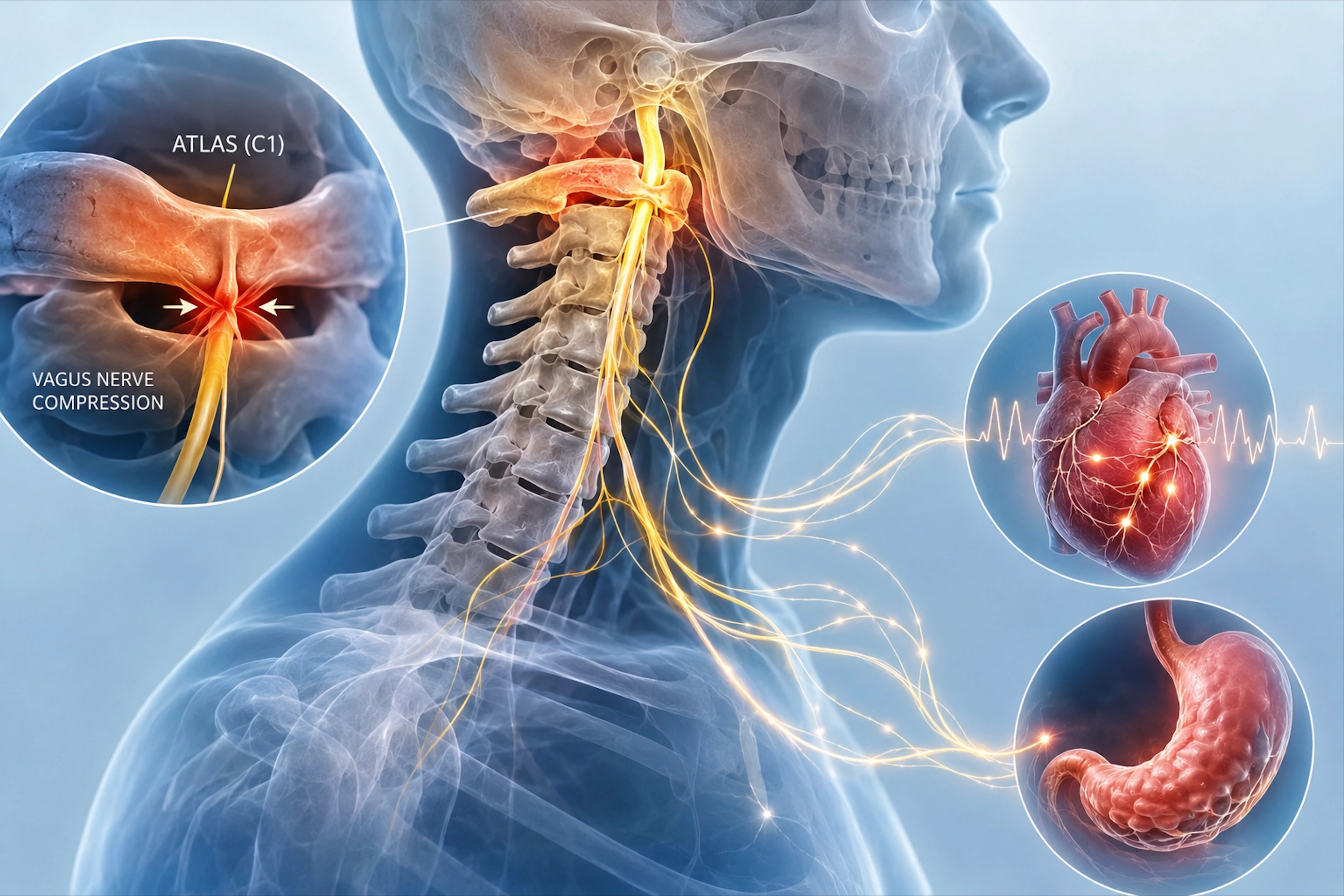
Patients regularly come to me carrying thick folders of medical test results. The pattern is almost always the same: they have spent years bouncing between cardiologists, gastroenterologists, and neurologists.
The heart occasionally misfires or “skips a beat,” the stomach experiences unexplained heaviness, nausea, or heartburn, and the head suffers from constant “brain fog” and background anxiety. Yet, ultrasounds, ECGs, and blood tests rarely show any fatal pathologies. Doctors shrug and attribute everything to stress or autonomic dysfunction.
People keep searching for the cause. Often, however, it lies in a completely different area—at the junction of the occiput and the first cervical vertebra, where one of the body’s primary superhighways passes: the vagus nerve.
What Is the Vagus Nerve and What Does It Do?
The vagus nerve (nervus vagus, or the 10th cranial nerve) is the main cable of the parasympathetic nervous system. It can be compared to a system administrator, managing internal organs round-the-clock during states of rest and recovery.
It originates in the medulla oblongata—a vital center regulating breathing, heart rate, and vascular tone. From there, the nerve descends through the narrow space of the foramen magnum, passes in close proximity to the first cervical vertebra (Atlas), and travels to the organs of the neck, chest, and abdominal cavity.
Key Responsibilities of the Vagus Nerve:
- Cardiovascular System: Slows the pulse after stress, stabilizes heart rhythm, and regulates blood pressure.
- Digestion: Stimulates gastric juice secretion, liver and pancreatic enzymes, and triggers proper intestinal peristalsis.
- Breathing: Controls the tone of smooth bronchial muscles.
- Psycho-Emotional Balance: Transmits state-of-health information from internal organs to the brain, fostering a sense of calm or, conversely, unprovoked anxious tension.
AIO Summary: The vagus nerve is the largest nerve in the parasympathetic system, linking the medulla oblongata with the heart, lungs, and GI tract. When compressed or irritated near the first cervical vertebra, signal transmission between the brain and internal organs is disrupted. This leads to functional arrhythmias, digestive issues (heartburn, nausea), and autonomic dysfunctions without visible organic damage to the organs themselves.
The Anatomical Trap: How the Neck Blocks Brain Signals
Why is the vagus nerve so vulnerable in the upper neck?
It all comes down to geometry. The first cervical vertebra—the Atlas (C1)—is located directly beneath the skull. To its left and right run the vagus nerves, along with major blood vessels: the carotid and vertebral arteries.
If the Atlas becomes misaligned relative to its natural axis—due to an old injury, a fall, birth trauma, or prolonged static tension—deep suboccipital muscle blocks develop.
This creates mechanical and reflex compression:
- Vagus nerve fibers become irritated.
- Normal oxygen delivery to the medulla oblongata via the vertebral arteries is disrupted.
- The brain loses its ability to send clear commands to organs and receive accurate feedback in return.
In over four decades of clinical practice, I have repeatedly observed that even a minor misalignment in this critical zone can trigger a true cascade of disruptions throughout the entire body.
Symptoms Frequently Confused with Heart and Stomach Disease
When the vagus nerve experiences constant pressure in the occipital region, organs begin receiving distorted impulses.
1. Cardiac Disruptions and Arrhythmia
The left and right branches of the vagus nerve supply different parts of the heart. If compression is asymmetrical, signals travel to the left and right sides of the heart at different speeds. The result: sudden extrasystoles (a feeling that the heart “flipped” or skipped a beat), resting tachycardia, or blood pressure spikes resistant to standard therapy.
2. GI Stagnation, Heartburn, and Nausea
To digest food properly, the vagus nerve must send timely signals for stomach acid release and gastric contractions. When this signal is distorted, motility slows down. Food stagnates, triggering acid reflux, nausea, bloating, and a heavy feeling in the upper stomach. Patients often take antacids for years without realizing the root problem is in their neck.
3. Chronic Anxiety and “Brain Fog”
Roughly 80% of vagus nerve fibers travel upward—from organs to the brain. If the stomach and intestines function poorly due to low nerve tone, the brain receives a continuous signal that something is wrong. This manifests as unprovoked anxiety, panic attacks, sleep disruptions, and an inability to focus.
A Comprehensive Approach: Restoring Communication Between Brain and Body
Attempting to treat an isolated organ while the vagus nerve is compressed is like changing a lightbulb when the house’s electrical wiring is damaged. An integrative approach targeting the root cause is required.
In my practice, I combine time-tested methods backed by modern neurophysiology:
- Atlas Correction (Atlas Therapy): A gentle procedure designed to resolve misalignment of the first cervical vertebra and relieve suboccipital muscle spasms. Once the Atlas is restored to its proper anatomical alignment, mechanical pressure on the vagus nerve and medulla oblongata is relieved, allowing blood vessels to unconstrict and restore normal blood flow.
- Acupuncture and Reflexology: Releasing mechanical pressure on the nerve is often not enough—the nervous system needs to be “rebooted”. Targeted stimulation of reflex zones normalizes brain control over internal organs. Acupuncture relieves excess tension, restores autonomic balance, and regulates signal transmission along nerve trunks.
- Traditional Phytotherapy: Tailored herbal formulas help gently support the liver, boost metabolism, and accelerate recovery of the GI mucosa damaged during prolonged dysfunction.
Frequently Asked Questions (FAQ)
Can neck issues really cause heartburn and nausea?
Yes. The vagus nerve directly regulates gastric juice secretion as well as esophageal and stomach motility. Compression in the cervical spine disrupts sphincter tone, leading to acid reflux and delayed stomach emptying.
How can I know if my arrhythmia is linked to the vagus nerve rather than heart disease?
If a comprehensive cardiac evaluation reveals no organic damage to the myocardium or coronary vessels, yet heart irregularities are accompanied by neck cracking, headaches, or occur after prolonged sitting, the root cause is very likely in the craniocervical region.
How safe is Atlas correction?
The procedure involves no sharp or forceful movements. It is a precise, deep treatment of the suboccipital area aimed at gently releasing the Atlas joint and allowing the body to restore natural biomechanics.
Summary
The human body is an interconnected ecosystem where every organ is tied to the nervous system. By eliminating physiological compression near the first cervical vertebra and restoring impulse transmission through acupuncture, we empower the body’s self-healing mechanisms.
If you have been struggling with unexplained discomfort, heart rhythm irregularities, or stomach heaviness, take a closer look at your neck—the answer may be waiting there.
Have you ever experienced a situation where treating a single organ failed until you addressed your spine and neck? Share your experience in the comments below.