

Medicine has traveled a colossal path, giving us the deepest knowledge of every cell in the human body. Nevertheless, in my more than forty years of clinical practice, I regularly encounter patients who have been walking in circles for years. They treat their stomach, take blood pressure medications, fight chronic migraines or constant fatigue, but the results remain only temporary. Symptoms may subside, but the disease seems to hide, only to manifest itself after some time with a new force or in a completely unexpected place.
Why is this happening? The problem lies in the paradigm of perception. The modern approach often tends to divide a person into separate systems: cardiology deals with the heart, neurology with nerves, and gastroenterology with digestion. However, the human body is not a set of independent parts assembled under one shell. It is a highly complex, inextricably linked holographic structure. Damage or dysfunction in one area inevitably triggers a cascade of compensatory changes throughout the body. That is why knee pain can be the result of a pelvic tilt, and the root cause of this tilt is a subtle displacement in the cervical spine.
Integrative innovative medicine, which I practice and develop, relies on synergy: it combines the fundamental wisdom of ancient Greek and Eastern medical traditions with cutting-edge discoveries in molecular biology. Our goal is not just to suppress the “alarm signal” in the form of a symptom, but to find a systemic malfunction and help the body restore its natural self-regulation. And in the vast majority of cases, this journey begins with the very foundation — the spine and the nervous system.
The Illusion of Symmetry and the Foundation of Our Body
Many people consider their posture to be quite normal until they conduct a simple experiment. Stand in front of a large mirror, relax, and look at yourself carefully. Most likely, you will notice that one shoulder is slightly lowered (most often the right one), and the pelvic line is not strictly horizontal — one side is slightly raised. This is the body asymmetry that the vast majority of people on the planet live with.
It would seem to be a small visual flaw, but biomechanics does not forgive such compromises. When the pelvis is at an angle, our body weight ceases to be distributed evenly between the left and right legs. The joints begin to experience an asymmetrical, unnatural load. Day after day, step by step, the cartilage tissue on the supporting side undergoes accelerated wear. Often, this is precisely why there is a need for endoprosthetics in old age — replacing a hip or knee joint with an artificial one. The body tried to compensate for the imbalance, but its resource of durability was exhausted.
But why does this imbalance occur in the first place? To find the answer, we need to look where the spine connects to the skull.
Atlas: The First Vertebra Holding the “Vault” of Health
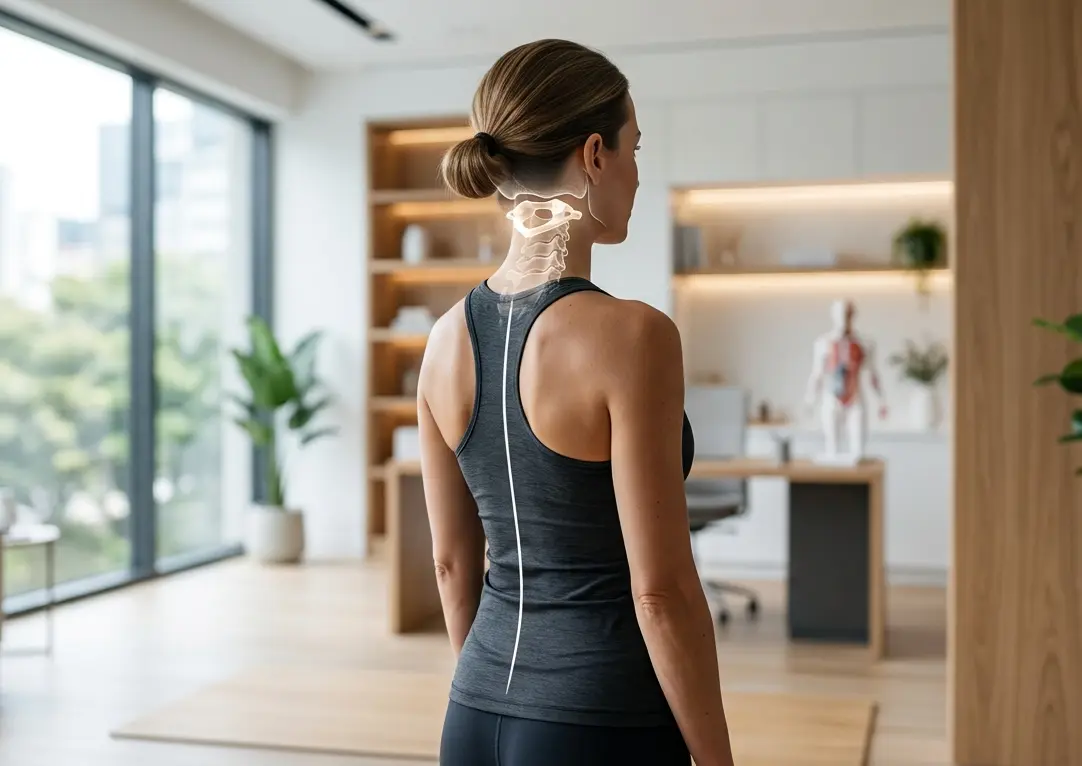
In Greek mythology, the titan Atlas held the celestial vault on his shoulders. In our anatomy, the first cervical vertebra, named in his honor, holds the weight of our head. This small bone element is the most important biomechanical and neurological node of the entire organism. And, according to clinical observations, it is displaced relative to its physiological axis in 95% of people.
This displacement is often laid down during the process of birth, and throughout life it is exacerbated by microtraumas, falls, bruises, or simply prolonged time in the wrong posture. Even a minimal deviation of the first vertebra, measured in fractions of a millimeter, can become a trigger for a huge spectrum of functional disorders.
Since the center of gravity of the head (which weighs about 5–7 kilograms) shifts, the body is forced to adapt. To keep the gaze on the horizon line, the brain commands the muscles of the neck and back to redistribute tension. The entire spine begins to bend, adapting to the displaced Atlas. This is how a scoliotic posture, a compensatory pelvic tilt, and that very difference in leg length are formed. Returning the Atlas to its anatomically correct position is the elimination of the mechanical root cause that forces the body to constantly be in a state of stressful compensation.
Neurological Conflict: When the Brain Loses Connection with the Body
Mechanical joint problems are just the tip of the iceberg. Much deeper consequences of Atlas displacement lie in the field of neurology. The first cervical vertebra is located in the most critical zone: this is exactly where the brain transitions into the spinal cord, and where the medulla oblongata passes.
The medulla oblongata is often called the “center of life.” It is a control room that, in the background, manages the most important vegetative functions: heart rate, respiratory rhythm, blood vessel tone (blood pressure), the functioning of the gastrointestinal tract, and even sleep-wake cycles. When the Atlas is displaced, microcompression occurs — mechanical pressure on the vagus nerve (Nervus vagus), the main information cable of the parasympathetic nervous system connecting the brain with the heart, lungs, and digestive system.
Cardiovascular System
The left and right vagus nerves innervate different parts of the heart. With asymmetrical pressure, the heart receives mixed, distorted signals, which can manifest as arrhythmias, unexplained palpitations, or blood pressure spikes.
Digestion
Stomach motility and enzyme secretion are disrupted. Patients can suffer from heartburn, nausea, or irritable bowel syndrome for decades, unaware that the problem stems from the cervical spine.
Psycho-Emotional Background
The vagus nerve is directly involved in regulating the stress response. Its chronic irritation keeps the body in a “fight or flight” state, which is subjectively experienced as constant anxiety, brain fog, decreased productivity, and depressive moods.
Blood Flow and Oxygen Deprivation
Through special openings in the lateral processes of the cervical vertebrae passes the vertebral artery, carrying oxygen-rich blood to the posterior regions of the brain. If the Atlas is rotated or displaced, these vessels can be subjected to slight compression or spasm by the surrounding tense muscles.
Even a slight decrease in the volume of incoming blood is perceived by the brain as a critical threat. Clinically, this can be expressed in the form of chronic headaches, migraines, tinnitus, dizziness with a sharp change in body position, as well as a decrease in cognitive functions — worsening of memory and concentration.
Why Do Isolated Methods Work Only Temporarily?
Understanding the importance of the spine, people often turn to classic massage or standard hands-on treatment methods. A specialist can relieve a muscle spasm or correct a joint, bringing temporary relief. However, the effect often disappears after a few days or weeks. Why?
The answer lies in neuromuscular memory. If a person has an anatomical displacement of bone structures, it is always supported and fixed by the surrounding muscles. The muscles are in spasm for a reason — this is a protective mechanism of the body trying to stabilize a damaged or unstable segment. The brain has already recorded this asymmetrical position as the “new normal” and constantly sends signals to maintain the spasm. If we simply mechanically put the vertebra back in place without retraining the nervous system, the brain, using its habitual muscle tension, will very soon return the structure to its original, crooked position. That is why a linear approach in medicine often fails.
Synergy of Methods: Reprogramming the “Software” and Fixing the “Hardware”
In our clinical approach, we use a strict sequence of methods that complement and reinforce each other. Only a comprehensive effect on the “hardware” part (joints, bones) and the “software” (nervous system, brain) is capable of giving a stable, long-term result.
1. Acupuncture: A Dialogue with the Brain
Acupuncture, whose roots go deep into Eastern and ancient Greek traditions, is not just about inserting needles. It is a high-precision method for normalizing the work of the brain’s control centers. Acupuncture points are areas with special electrical resistance and a dense accumulation of nerve endings. By inserting the thinnest needle, we send a specific signal to the central nervous system. Needles work like antennas, helping to dissipate excess tension and restore normal impulse transmission. This allows us to calm an overloaded nervous system, remove pathological muscle memory, and prepare the body for structural changes.
2. Reflexology and gentle, non-forceful techniques: Restoring Mobility
Against the background of a relaxed nervous system and removed muscle blocks, we apply methods of gentle, non-forceful influence. Depending on the indications, this can be either reflexology (more accented work with joints) or gentle, non-forceful techniques (gentle, barely perceptible impact on the fascia, internal organs, and craniosacral rhythm). The task of this stage is to carefully restore the lost mobility to the joints and organs, eliminate local tension, and restore proper blood microcirculation.
3. Atlas Therapy: Returning to Factory Settings
When the nervous system is ready and compensatory blocks are removed, a gentle correction of the first cervical vertebra is performed. Modern Atlas therapy is not about sharp jerks of the neck. It is a safe, drug-free procedure that allows the Atlas to smoothly assume its anatomical position. The medulla oblongata is released, pressure is removed from the vagus nerve, and full blood flow through the vertebral arteries is restored.
The Regeneration Process: Returning Vital Energy
It is important to understand that correcting the root cause is not the end of the journey, but only the beginning of the process of global restructuring of the organism. A body that has lived in a crooked state for years or decades begins to rebuild itself.
After returning the Atlas to its correct position, the center of gravity is restored. Patients often note that it becomes easier for them to keep their back straight without additional effort. Over time, the pelvis returns to a horizontal position, and the load on the leg joints evens out. As the released vagus nerve restores the transmission of correct signals, many notice an improvement in digestion, stabilization of blood pressure, and deep, even breathing.
Moreover, this process has a pronounced aesthetic effect. Health and beauty are inseparable. When blood supply improves and the free flow of lymph is restored, tissues receive more oxygen and nutrients. The skin becomes more elastic, and swelling decreases. Due to the straightening of posture, tension leaves the neck muscles, which can contribute to the reduction of the “dowager’s hump” in women and the visual elongation of the neck. A person literally straightens their shoulders and becomes taller.
The Path to Conscious Health
The body possesses a colossal resource for self-healing. A doctor does not “fix” a patient like a mechanic fixes a car; the task of true medicine is to remove obstacles — mechanical, neurological, biochemical — that prevent the body from healing itself.
The use of phytotherapy — individually selected medicinal plants according to the recipes of ancient Greek medicine — additionally supports this process from within, providing the organs with the necessary nutritive base.
Treating symptoms may give a respite, but only finding and eliminating the root cause grants freedom. Studying the signals of your body, understanding its complex and beautiful architecture is the first and most important step toward a long, active, and truly high-quality life.
Medical Disclaimer. This article was prepared by Professor Vasileios Giatskos, MD, PhD, solely for informational and educational purposes and is not a substitute for an in-person medical consultation, diagnosis, or treatment. Any disease requires an individual clinical examination. Do not use the information provided for self-diagnosis.